
The Programmatic Ecosystem: Where Advertisers and Publishers Meet in the Open Web
Ever wonder how digital ads appear on websites so quickly? Dive into the programmatic advertising ecosystem—a sophisticated marketplace where advertisers and publishers connect through real-time auctions that happen in milliseconds. This guide explains how RTB works, the key players involved, and why this technology has transformed digital advertising into a $150+ billion industry.
8/7/20256 min read
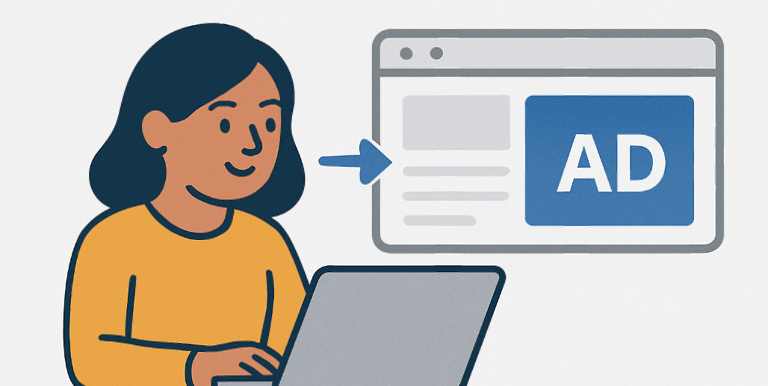
Imagine this: you pull your phone or laptop out to do some casual web-browsing. Did you know that every time you load a webpage, an invisible auction happens within milliseconds? Behind the scenes, advertisers compete to show you their message while publishers maximize the value of that precious screen real estate on your device. Behind this split-second drama lies one of the most sophisticated marketplaces ever created—where billions of dollars change hands daily through automated systems most people never see or are aware of.
The digital advertising landscape has evolved dramatically over the past two decades, transforming from simple banner ads sold through direct relationships into a sophisticated, automated marketplace. At the heart of this evolution lies programmatic advertising—a complex ecosystem where advertisers and publishers come together through technology-driven exchanges to buy and sell ad inventory in real-time.
Understanding the Digital Advertising Marketplace
Think of programmatic advertising as a stock exchange, but instead of trading shares, participants buy and sell advertising space. Just as financial markets connect buyers and sellers through sophisticated matching systems, the programmatic ecosystem connects advertisers seeking to reach audiences with publishers who have valuable ad inventory to monetize.
This marketplace operates on a fundamental principle: matching the right ad with the right user at the right moment, all within milliseconds of a webpage loading.
The Two Sides of the Programmatic Marketplace
The Buy Side: Advertisers and Their Technology Stack
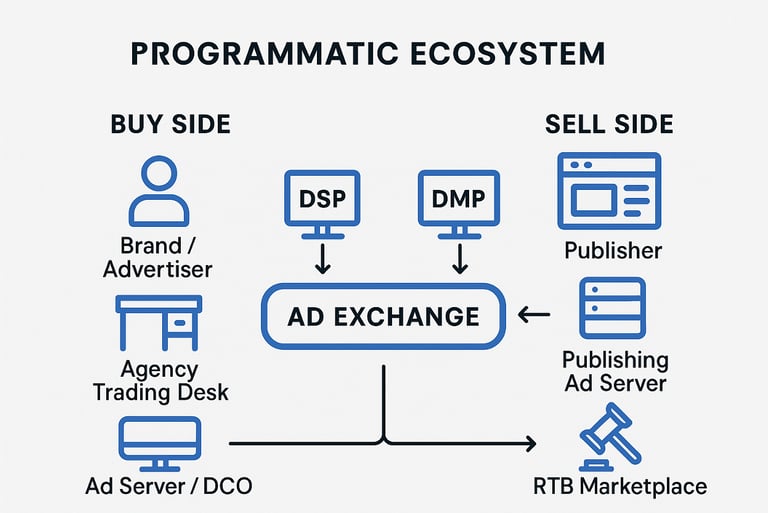
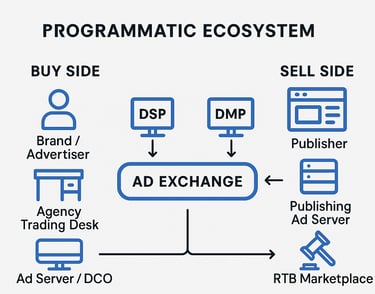
The buy side represents advertisers—brands, agencies, and marketers who want to purchase ad space to reach their target audiences. These participants don't typically buy ads directly from individual websites anymore. Instead, they use sophisticated technology platforms:
Demand-Side Platforms (DSPs) serve as the primary interface for advertisers in the programmatic ecosystem. These platforms allow buyers to access multiple ad exchanges simultaneously, set targeting parameters, manage budgets, and optimize campaigns in real-time. Popular DSPs include Google's Display & Video 360, Amazon DSP, and The Trade Desk.
Data Management Platforms (DMPs) and Customer Data Platforms (CDPs) help advertisers organize and activate their audience data, enabling more precise targeting based on demographics, behaviors, interests, and past interactions.
Ad Verification and Brand Safety Tools ensure that ads appear in appropriate contexts and reach real human users rather than bots.
The Sell Side: Publishers and Their Monetization Arsenal
The sell side consists of publishers—websites, mobile apps, and digital content creators who have ad inventory to sell. Publishers have developed their own sophisticated technology stack to maximize revenue:
Supply-Side Platforms (SSPs) help publishers manage their ad inventory across multiple demand sources. These platforms optimize which ads to show and at what price, often conducting real-time auctions among multiple buyers. Major SSPs include Google Ad Manager, Amazon Publisher Services, and PubMatic.
Header Bidding technology allows publishers to offer their inventory to multiple demand sources simultaneously before making calls to their ad server, increasing competition and potentially boosting revenue.
Yield Optimization Tools help publishers balance user experience with revenue generation, determining the optimal number and placement of ads.
The Programmatic Transaction: Real-Time Bidding in Action
At the heart of programmatic advertising lies Real-Time Bidding (RTB), a process that transforms how digital ads are bought and sold. RTB is an automated auction system where ad inventory is purchased and sold on a per-impression basis, in real-time, as users load webpages. This technology enables advertisers to bid on individual ad impressions based on what they know about the user and the context, rather than buying bulk ad placements in advance.
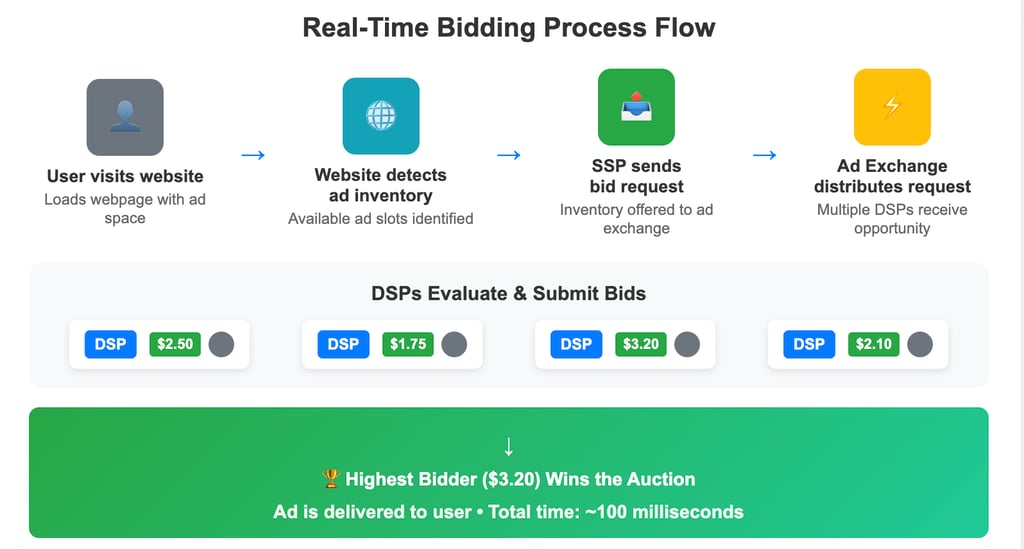
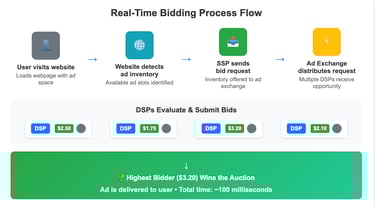
When a user visits a website, this incredibly complex RTB process unfolds in the time it takes the page to load—typically under 100 milliseconds:
Step 1: The Bid Request Generation The moment a user loads a webpage with ad space, the publisher's ad server recognizes the available inventory and sends a bid request through their SSP. This bid request contains crucial information: details about the available ad slot (size, position, format), anonymized user data (in privacy-compliant ways), page context, and targeting parameters that help buyers evaluate the opportunity.
Step 2: The Real-Time Auction This bid request instantly reaches multiple DSPs through various ad exchanges, triggering simultaneous auctions. Each DSP rapidly evaluates whether this impression matches their advertisers' targeting criteria—considering factors like audience demographics, browsing behavior, geographic location, and campaign objectives. Based on this analysis, they determine how much to bid, reflecting the perceived value of reaching this specific user at this specific moment.
Step 3: The Winner Takes All Within milliseconds, the highest bidder wins the auction and secures the right to display their ad. The transaction typically follows a second-price auction model, where the winner pays just above the second-highest bid rather than their maximum bid amount. This mechanism encourages honest bidding while ensuring efficient price discovery.
Step 4: Ad Delivery and Performance Tracking The winning ad creative is immediately delivered and displayed to the user, often before they even notice the page has finished loading. Simultaneously, various tracking mechanisms activate to measure viewability, engagement, click-through rates, and other performance metrics that will inform future bidding decisions and campaign optimizations.
Key Players in the Programmatic Ecosystem
Ad Exchanges: The Central Marketplaces
Ad exchanges serve as the neutral ground where buy-side and sell-side platforms meet. These digital marketplaces facilitate the auction process and ensure smooth transactions. Google Ad Exchange remains the largest, but other significant players include OpenX, Index Exchange, and Magnite.
Data Providers: The Intelligence Layer
Third-party data providers enrich the ecosystem by offering additional audience insights, contextual data, and measurement capabilities. Companies like LiveRamp, Lotame, and Nielsen provide crucial data services that help both advertisers and publishers make more informed decisions.
Verification and Measurement: The Trust Layer
Brand safety vendors, viewability measurement companies, and fraud detection services ensure the integrity of programmatic transactions. Companies like Integral Ad Science, DoubleVerify, and MOAT provide the verification layer that builds trust between buyers and sellers.
The Benefits of Programmatic Advertising
For Advertisers:
Scale and Efficiency: Access to vast inventory across the open web through a single interface
Precision Targeting: Ability to reach specific audiences based on detailed criteria
Real-Time Optimization: Campaigns can be adjusted instantly based on performance data
Transparency: Better visibility into where ads are placed and how budgets are spent
Cost Effectiveness: Automated bidding often results in more efficient media buying
For Publishers:
Revenue Optimization: Competition among multiple buyers typically drives higher prices
Fill Rate Improvement: Access to more demand sources reduces unsold inventory
Automation: Reduced need for manual sales processes and ad trafficking
Global Reach: Ability to monetize audiences worldwide through programmatic demand
Challenges in the Current Ecosystem
Despite its benefits, the programmatic ecosystem faces several significant challenges:
Privacy and Data Protection regulations like GDPR and CCPA have fundamentally changed how user data can be collected and used, forcing the industry to develop new targeting and measurement approaches.
The Cookieless Future presents perhaps the biggest challenge, as the deprecation of third-party cookies requires new methods for audience targeting and attribution.
Brand Safety Concerns remain paramount, as automated buying can sometimes result in ads appearing alongside inappropriate content.
Ad Fraud continues to plague the ecosystem, with sophisticated bot networks and invalid traffic sources draining advertiser budgets.
Supply Chain Complexity often obscures the true cost and value exchange, with multiple intermediaries taking fees along the way.
The Evolution Toward Greater Transparency
The programmatic ecosystem is evolving toward greater transparency and efficiency. Initiatives like ads.txt and sellers.json help verify the legitimacy of inventory sources. Private marketplaces (PMPs) and programmatic guaranteed deals offer more direct relationships between buyers and sellers while maintaining the efficiency of automated buying.
First-party data strategies are becoming increasingly important as publishers and advertisers prepare for a future with less reliance on third-party cookies. Publishers are investing in direct relationships with their audiences, while advertisers are focusing on their own customer data and contextual targeting approaches.
Looking Forward: The Future of Programmatic
The programmatic ecosystem continues to mature, with several trends shaping its future:
Connected TV (CTV) and Over-The-Top (OTT) advertising are bringing programmatic principles to television, creating new opportunities for both advertisers and content creators.
Artificial Intelligence and Machine Learning are becoming more sophisticated, enabling better prediction of user behavior and ad performance.
Privacy-First Solutions like Google's Privacy Sandbox and industry initiatives around contextual targeting are reshaping how audiences are reached without compromising user privacy.
Retail Media Networks are creating new walled gardens where retailers use their first-party data to offer advertising opportunities, adding another layer to the programmatic landscape.
To Wrap it Up
The programmatic ecosystem represents one of the most sophisticated examples of digital marketplace technology in action. By connecting advertisers and publishers through automated, real-time auctions, it has democratized access to digital advertising while creating unprecedented opportunities for targeting and optimization.
As the ecosystem continues to evolve in response to privacy regulations, technological changes, and market demands, understanding its fundamental mechanics becomes increasingly important for anyone involved in digital marketing, publishing, or AdTech.
The future promises even more innovation, with emerging technologies and privacy-focused solutions continuing to reshape how brands connect with audiences in the open web. For businesses looking to navigate this complex landscape, success will depend on understanding not just the technology, but the strategic implications of how buyers and sellers interact in this dynamic digital marketplace.
The programmatic ecosystem may be complex, but its core mission remains elegantly simple: connecting the right message with the right person at the right time, powered by technology that makes it all happen in the blink of an eye.